When you retire, everything changes in your life. You no longer receive a monthly paycheck, but you’re no longer making a commute, and you have control of your free time. One of the biggest changes that people don’t realize is how retirement affects your insurance. Retirement not only affects insurance benefits from work, but other types of insurance as well. Here’s how your insurance benefits and needs shift depending on when you retire, what happens to each type of policy you own, and how to keep your costs down once you’re living on a fixed income.
How Your Retirement Age Changes the Picture
When you stop working has a significant influence on what happens to your insurance when you retire. If you’re someone who gets insurance through their employer, the earlier you leave the workforce, the bigger the insurance gap you need to plan around.
Take a look at how different retirement ages affect insurance benefits.
FIRE and Early Retirees
If you’re part of the FIRE (Financial Independence, Retire Early) movement, you’re looking to leave your job in your 40s or 50s (or your 30s if you’re really motivated). Since most Americans get their health insurance through their employer, this is your biggest exposure. Medicare doesn’t start until 65, so you could be covering the full cost of health insurance for a decade or more on your own.
Most early retirees end up on an Affordable Care Act marketplace plan where the premium is based on your income, not your assets. In my experience, FIRE movement followers typically focus on keeping their income and expenses low, so this is actually good news. If you’ve structured your withdrawals carefully, a lower taxable income in early retirement may qualify you for meaningful premium tax credits that make health insurance affordable. Otherwise, you could be spending thousands per month on health insurance that could wreck your plans for FIRE early retirement.
Retiring in Your 60s
If you’re leaving work between ages 62 and 67, you’re like most Americans. While you can start claiming Social Security benefits at age 62, you don’t have access to Medicare until age 65. For these retirees, you’ll need to purchase health insurance another way.
Under 65 retirees may purchase health insurance through COBRA or the ACA marketplace. If your spouse is still working, you may be able to be covered under their employer coverage.
When you retire at or after 65, your health insurance needs are largely taken care of. You’ll be able to sign up for Medicare and get additional benefits through supplemental plans for an additional premium.
Keep in mind that health insurance is not your only concern. Other types of coverage offered through your employer, like dental, life, and disability insurance, typically end when you retire. However, some insurers allow you to continue coverage if you’re willing and able to pay the full premium.
Late Retirees (70+)
Even if you plan on working past age 65, it is crucial that you sign up for Medicare at age 65. For every year that you don’t register, you’ll owe a late enrollment penalty. The penalty is twice the number of years you don’t sign up times 10%. Even if you have health insurance through your employer, it pays to sign up during the initial seven-month enrollment window – three months before and three months after your birth month. In my experience, older workers may be eligible for a special enrollment window that avoids these penalties. Talk with your local Medicare office to see if you qualify.
The surprise for older retirees is usually auto insurance. Even though you’re driving less because you’re no longer commuting, rates tend to climb starting around 65. In my experience, premiums keep rising through your 70s and 80s as insurers price in age-related risk of accidents and other claims.
How Retirement Impacts Each Type of Insurance
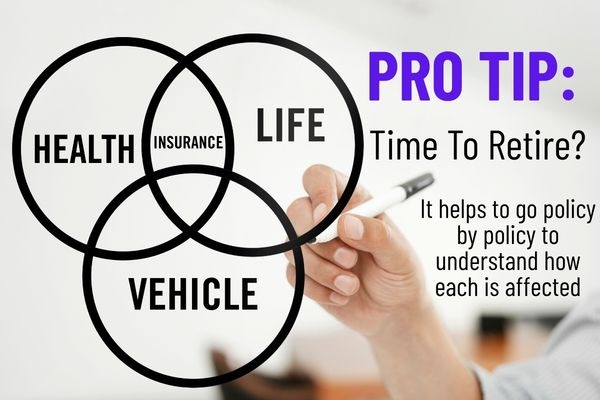
Once you know when you plan on retiring, it helps to go policy by policy to understand how each is affected. In my experience, some insurance premiums and coverages are based on age, while others are based on activity.
Medical
If your health coverage came from an employer, it typically ends on your last day or shortly after. COBRA can bridge the gap for up to 18 months. However, the costs can rise dramatically from what you’re used to paying because you’re now responsible for the full premium plus an administrative fee. These added costs can be a shock to your retirement budget after years of subsidized employer coverage.
For most people retiring before 65, an ACA marketplace plan is the more sustainable long-term option, especially once your income drops. At 65, you’ll want to enroll in Medicare during your initial enrollment window to avoid a late penalty that follows you for the rest of your life. These penalties are steep and can make what’s supposed to be a low-cost medical insurance option unaffordable on a fixed income.
Dental
Dental coverage gets overlooked by most retirees, and it’s one of the first things people lose without realizing it. Original Medicare doesn’t cover routine dental care, so you’ll need either a standalone dental plan or a Medicare Advantage plan that bundles it in. Not all Medicare Advantage plans cover dental care, so review your options carefully before selecting a plan.
Even if you’re able to keep your existing health insurance from your employer, don’t assume your dental benefits carry over just because your health insurance does.
Life
Group life insurance through an employer is one of the most common casualties of retirement. Most group policies end when you leave your job, or shrink to a fraction of the death benefit that you had.
Some employers offer a conversion option to turn it into an individual policy, but converted premiums are usually much higher than shopping for a new policy on your own while you’re still in decent health. For this reason, I typically recommend clients who are in good health purchase life insurance on their own.
On the flip side, your life insurance need often shrinks in retirement if your kids are grown and self-sufficient. One of the major reasons to buy life insurance is to replace lost income when someone dies. When you retire, that need no longer applies since you have investments, rental properties, and other sources of income that continue on even after you pass away.
It can still be a smart idea to keep life insurance when you retire. I recommend clients keep a policy in place for final expenses, estate taxes, or to protect a surviving spouse’s income.
Disability
This one is the easiest to check off your list. Disability insurance exists to replace income. However, since you’re no longer earning a regular paycheck, there’s nothing to replace. Once you retire and start drawing on Social Security, a pension, retirement accounts, or other sources of recurring income, the need for it largely disappears.
Auto
Auto insurance is a tricky situation for retirees, especially those who are older. While auto insurance rates typically drop once the commute disappears, your mileage may actually increase in retirement with road trips to explore the country and to visit family and friends.
Even if your mileage drops, that only shaves a few percentage points off your premium. However, your premiums may go up as insurers start factoring in age-related risk more heavily starting around 65. Based on my experience, rates continue climbing through your 70s.
Homeowners
Homeowners insurance doesn’t change automatically at retirement either. Some insurance carriers offer senior or retiree-specific discounts that can keep costs low.
The biggest change in homeowners premiums in retirement is when you move into a smaller home. Many retirees sell their larger homes where they once raised families and trade them in for a smaller condo or townhome with lower utilities and maintenance needs. However, keep in mind that some parts of the country carry higher insurance costs due to the risk of natural disasters, like Florida and California. So, even if you trade down and move to one of these areas, your insurance rates may actually go up.
Tips to Reduce Insurance Costs in Retirement
- Shop your auto and home policies. Don’t assume loyalty pricing is competitive. Get quotes from at least three insurers when you retire.
- Report your new mileage immediately. Ask about low-mileage discounts or pay-per-mile programs if you’re driving significantly less.
- Bundle home and auto. This is still one of the simplest ways to cut costs on both policies, whether you’re working or retired.
- Manage your income if retiring before 65. Keeping your modified adjusted gross income (MAGI) below ACA subsidy thresholds can meaningfully lower your marketplace premium.
- Re-evaluate your life insurance need. Decide whether you still need your current death benefit, or whether a smaller policy for final expenses makes more sense. Retirees with larger estates may need life insurance to cover assets beyond the annual gift tax exclusion limits.
- Take a mature driver course. Many states offer an auto insurance discount for drivers 55 and older who complete one.
- Increase deductibles. By taking on a larger part of the expense of filing claims, you’ll receive lower premiums.
The Bottom Line
Retirement not only affects your paycheck, but it can change what your insurance benefits are and how much it costs. Policies tied to your job, like health, dental, life, and disability, need the most attention since they typically lapse the moment you stop working. The policies you keep, like auto and home, won’t get cheaper on their own, so you’ll need to ask for discounts and comparison shop to save money. Whether you’re retiring at 45 or 75, take time to review every policy you own before your last paycheck hits your bank account. And if you’re not sure how to evaluate them, book an appointment with a licensed agent to get an expert opinion.
The information provided on this website is for general informational and educational purposes only and should not be considered legal, financial, or insurance advice. While we strive to keep content accurate and up to date, insurance laws, policies, and regulations can vary by state and may change over time.
Nothing on this site constitutes professional advice or a recommendation of any specific insurance product, provider, or strategy. You should consult with a licensed insurance agent, financial advisor, or legal professional regarding your individual situation before making any decisions.
Sources
- Healthinsurance.org, Your guide to early retirement health insurance options. Published June 16, 2026.
- Team Hewins, Understanding Early Retirement Health Insurance: Essential Strategies and Options. Published February 1, 2025.
- ValuePenguin, Best Health Insurance for Seniors and Retirees. Published July 24, 2026.
- Kiplinger, You Retired and Stopped Commuting. How Do You Lower Car Insurance Costs?. Published October 18, 2025.
- Forbes Advisor, Best Car Insurance For Seniors. Published July 1, 2026.
- U.S. News, Homeowners Insurance for Seniors. Published June 2, 2026.
- Western & Southern, Can You Keep Life Insurance When You Retire? What to Know. Published July 25, 2025.
- Medicare.gov, Avoid late enrollment penalties. Accessed July 24, 2026.
- Medicare.gov, Working past 65. Accessed July 24, 2026.
- Medicare.gov, When does Medicare coverage start? Accessed July 24, 2026.