Individual disability insurance (IDI) isn’t making headlines and it may not be the first coverage your family’s insurance broker or financial advisor recommends. But IDI can protect your income so you don’t have to tap into savings or investments if you’re unable to work due to illness or injury. It’s important to understand the role this coverage plays in your financial security and the various options available.
Is Paid Medical Leave or Short-term Disability Enough for Most Workers?
Short-term disability insurance is typically provided by employers, often on a cost-shared basis. Even in states that don’t require paid medical leave, employers may offer group policies on a voluntary basis.
As more states across the country introduce paid family and medical leave programs or group short-term disability coverage, you might think your income is secure if you become ill or injured off the job.
But that’s not necessarily true if your illness or injury exceeds the limited timespan for short-term disability or paid medical leave benefits.
For instance, New York and New Jersey offer workers 26 weeks of job-protected, paid leave at a percentage of their salary for short-term disability. Other states cap paid medical leave at 12 weeks within a 12-month time period.
The duration for mandated disability or medical leave is one issue; the amount of the benefit is another problem for many workers.
Where Short-term Disability Benefits Fall Short
If you look at New York as an example, the state offers a maximum weekly benefit of just $170. Most states offer more for paid medical leave, often up to 90% of the claimant’s salary up to a percentage of the state’s average weekly wage.
Oregon, recognized as one of the best states for PFML, offers a maximum weekly benefit of $1,636 for the highest paid workers in 2026. That equals $85,072 per year, which may not be enough for someone to live comfortably in the state.
Based on a recent study from SmartAsset.com, a single adult in Oregon needs $104,666 to live comfortably, while a family of four needs more than $261,000. That allows 50% of income to cover “needs,” including housing and food, 30% on wants, and 20% for savings or debt repayment.
Add medical bills for someone who is out of work for a long-term illness or injury, and living expenses may cost even more. That’s why IDI coverage is so important not just for high earners, but anyone who wants to protect their financial future.
Types of Disability Insurance for Longer Term Needs
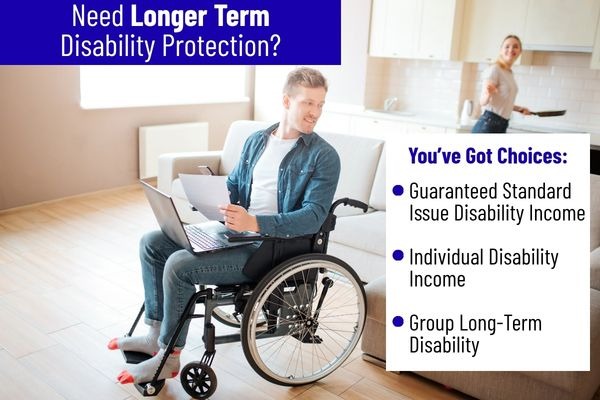
For a longer term plan, you have choices: Guaranteed standard issue disability income, individual disability income, and group long-term disability.
Group LTD is not the same as group or individual disability insurance. With an LTD plan, your employer owns the policy. On the other hand, an individual disability insurance or disability income insurance plan is fully portable. You own the policy and you can take it with you when you change jobs.
The benefit amounts and waiting periods might also be different, along with the duration.
Group LTD
Group long-term disability (Group LTD) is designed to kick in after your short-term disability ends, often with a 90- or 180-day waiting period. It may pay 40% to 70% of your salary, with executive carve-outs available for a maximum payment as high as $15,000 per month.
It’s a voluntary benefit provided by employers; premiums can be paid by the employee, the employer, or on a cost-shared basis. It’s an affordable option for workers who want income security should they become disabled.
Group LTD isn’t portable, which means the coverage doesn’t continue if you change jobs. You’d need to write a new policy with your new employer to ensure continued coverage.
It often doesn’t cover bonuses or commissions, since these aren’t part of your base salary. It’s paid for with pre-tax dollars, which means the benefits are taxable. Your benefit will be reduced by taxes at the time you may need extra income the most.
Additionally, your LTD benefits might be reduced by any Social Security Disability Income (SSDI) payments you receive.
On the positive side, most people can participate in their employer’s group LTD plan regardless of their health, age, or any pre-existing conditions.
Guaranteed Standard Issue Disability Income
Within the options for individual disability insurance, workers may have a choice between a guaranteed standard issue policy, if their employer offers it, or individual disability income.
A GSI policy requires no medical underwriting – every worker is guaranteed coverage if they opt into the plan. A GSI plan may not offer the same robust benefits as an IDI policy, and it’s typically not customizable. But it can provide affordable coverage for workers with pre-existing conditions.
It’s different from an LTD plan because it’s portable, may have higher benefit limits, and may include executive carve-outs to offer income replacement at levels high earners need to protect their lifestyle and financial security.
Plus, employers who choose to pay premiums for their workers can write off those payments as an expense. Employers can use IRS Code 162 to cover the taxes on those premium payments for employees, as well.
The employer pays the premiums and reports them as W-2 income for the executive employee. Then, the business pays a cash bonus to the executive employee to cover the income tax on the premium amount.
GSI coverage may also include a Return-of-Premium (ROP) rider. This allows employees to build cash assets if they remain with the company and don’t file a claim after a pre-determined period of time. Refunds can be 50%, 80%, or 100% of premium rates, returned after 10 years without a claim.
These advantages make GSI coverage an enticing incentive to reward high-performing employees and aid in recruiting and retention at the executive level.
Individual Disability Insurance
IDI also has a number of advantages as an employer-provided benefit. Premiums may be higher and are dependent upon medical underwriting. As with a GSI policy, the employee owns the policy and can make premium payments with after-tax dollars, resulting in a higher benefit amount if the employee makes a claim.
Unlike group LTD or GSI coverage, IDI is also available for self-employed individuals and 1099 contractors, written as a private policy.
Own Occupation vs. Any Occupation Coverage
LTD, GSI, and IDI plans may offer “own occupation” or “any occupation” coverage. But an LTD plan often starts as “own occupation” and shifts to “any occupation” after two years.
What’s the difference? Own occupation coverage pays benefits if you file a claim because you’re unable to work in your chosen field. On the other hand, “any occupation” coverage will only cover you if you’re unable to work at all, in any job that fits your education, training, or experience.
If you work in a highly specialized field that requires years of education, training, and unique skills, you’ll want to consider “own occupation” coverage, which often has higher premium rates.
On the other hand, if you have easily transferable skills, an “any occupation” policy offers a budget-friendly alternative.
Do You Need an IDI Policy to Protect Your Income?
Nearly 29% (28.7%) of adults in the US have a disability, according to CDC data.
These range from mobility difficulties to hearing or vision loss, cognitive issues, or an inability to perform activities or daily life or do errands without help. Many adults have more than one disability, which can profoundly affect their ability to work.
If you’re working today, disability insurance should play a part in your financial planning. But the options can be complicated to understand. Speak with your benefits advisor at work or pursue a private policy with your insurance broker. You might save money by bundling benefits like DI and life insurance.
The information provided on this website is for general informational and educational purposes only and should not be considered legal, financial, or insurance advice. While we strive to keep content accurate and up to date, insurance laws, policies, and regulations can vary by state and may change over time.
Nothing on this site constitutes professional advice or a recommendation of any specific insurance product, provider, or strategy. You should consult with a licensed insurance agent, financial advisor, or legal professional regarding your individual situation before making any decisions.
Sources
https://smartasset.com/data-studies/state-salary-living-comfortably-2025
https://www.seltzerlegal.com/blog/need-group-long-term-disability-individual-disability-insurance
https://www.investopedia.com/terms/a/any-occuption.asp