To save money on auto insurance, common advice says that you should increase your deductible. This makes sense because when you have more skin in the game, you’re less likely to file a claim. Insurance companies offer lower premiums to customers who file fewer claims. However, choosing a higher deductible isn’t always the best option for your insurance policy. Here’s everything you need to know about car insurance deductibles, including what is a deductible, how to calculate if a higher deductible makes sense, and how to set money aside so you have the cash if you ever need to file a claim.
What Is a Deductible?
A deductible is the amount of money you must pay out of pocket before the insurance company pays out. Deductibles are part of almost every type of policy, including auto, homeowners, renters, and medical insurance. In general, your premiums go down as your deductible increases, and vice versa.
If you file a claim, you don’t pay the deductible to your insurance company. Instead, you’ll pay the repair shop your portion, and the insurance company pays the rest. When there’s a total loss of your vehicle, the insurance company writes you a check for the total value of the vehicle, minus your deductible.
For example, say that you’ve been in an accident and it costs $3,000 to repair your vehicle. If you have a $500 deductible, you’ll pay $500 and the insurance company covers the remaining $2,500.
How Much Are Deductibles?
The average car insurance deductible is $500, but drivers can typically choose any amount between $100 and $2,000. The most common choices are $500 and $1,000.
Car insurance deductibles apply to both collision and comprehensive coverage. However, it doesn’t apply to liability coverage. If you’re in an accident and the other driver is at fault, you’ll file a claim against their policy and won’t need to pay your insurance deductible.
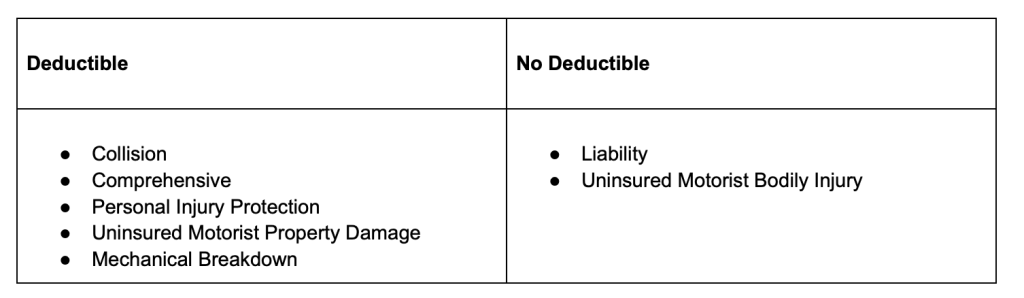
The good thing is that you can choose different deductibles for each type of coverage within your auto policy. And not all types of coverage require a deductible. Here are the most common coverage types and whether or not they require a deductible:
Since each of these types of insurance carries a different deductible amount, I often counsel my clients to customize their policy deductibles to find auto insurance that meets their budget.
How Much Money Can You Save By Choosing a Higher Deductible
If you can stay claims-free, you can save a lot of money by choosing a higher deductible. My wife and I haven’t had an accident in more than a decade, so we’ve experienced a double benefit on our auto insurance policies – lower rates due to no claims and a reduced premium from a higher deductible.
But the reality is that most drivers will need to file a claim at some point. The magic of saving money depends on how you drive and which deductible you choose.
The beauty is that you don’t need to choose the highest deductible option to save money on your auto insurance. Drivers can often save up to 20% on car insurance just by raising the deductible from $500 to $1,000. Keep in mind that how much you’ll actually save on your policy depends on your driving record, vehicle, miles driven per year, and where you live.
The Breakeven Calculation
While you’ll save real money by choosing a higher deductible, there is a catch. You need to avoid filing a claim long enough for the savings to make up for the higher out-of-pocket costs. Here’s how to figure out the breakeven period for increasing your car insurance deductible.

The breakeven formula is simple:
(Higher Deductible − Lower Deductible) ÷ Annual Premium Savings = Years to Break Even
Calculate the increase in deductible by subtracting the lower deductible from the higher one. This determines how much extra you’ll need to pay out of pocket when filing a claim. Then figure out how much you’ll save each year by making this change by calculating the difference in premiums. Divide the difference in deductible by the annual premium savings. That result is how many years it will take to break even.
One of my clients is a 35-year-old male who lives in California and drives 12,000 miles a year in a Honda Civic. If he were to switch from a $500 deductible to $1,000 for collision coverage, he would save $396 per year. In my experience, this is a no-brainer because he can recover the $500 in just over one year of being claims-free.
However, if the savings were smaller at just a $50 difference, that would only save $100 a year. In that scenario, it would take five years to break even on increasing your car insurance deductible.
While the average person goes years without filing a claim, the math only works if you do something productive with the savings and have the money to pay when you need it.
Can You Actually Pay That Deductible?
Higher deductibles only make sense if you can cover the additional cost when you need to pay. If you don’t have the money, you won’t be able to file a claim, or you’ll need to go into debt to pay it. Putting the charges onto a high-interest credit card or applying for a loan only makes a stressful situation worse.
To avoid this scenario, I recommend clients set aside enough money to cover their insurance deductibles. The best place to set aside this money is in a high-yield savings account with no monthly fees. While you may not have all of the money right away, you can contribute to the account each paycheck until your balance meets (or exceeds) your deductible.
Keep in mind that if you have multiple claims within a short period of time, you can quickly run out of money in this fund.
How to Set Money Aside for Your Deductible
Having a strong emergency fund is the best way to offset the risk of a high-deductible plan. If you always have your out-of-pocket amount set aside in case of emergencies, you won’t have to worry about being hit with a large repair bill.
- Make it a dedicated savings goal. Open a separate high-yield savings account labeled “car fund” or “insurance deductible.” Keep the balance at or above your deductible.
- Fund it with your premium savings. If switching to a $1,000 deductible saves you $25 per month, set up an automatic transfer of that $25 to the dedicated account. This gets you into the habit of saving money and builds a safety net with your insurance savings.
- Set a funding timeline. If your deductible is $1,000 and you can save $100 per month, you’re fully funded in 10 months. Everything after that can go toward paying off high-interest debt, retirement savings, or building up your emergency.
My online bank allows me to create multiple accounts with no monthly fees. So, I create accounts for each of my deductibles and annual premiums. This way, I can contribute to each one in smaller amounts throughout the year, then have the money readily available when I need.
When to Choose a Lower Deductible
If you’re still uncertain whether it makes sense to choose a lower deductible or a higher one, here are some factors to consider.
- Your emergency fund is thin. If you don’t have at least your deductible amount in liquid savings, a lower deductible is the safer call.
- You drive frequently or in high-risk conditions. If you drive often or in high-risk areas, a lower deductible might be the better choice. The more miles you drive, the more likely it is that you’ll be in an accident.
- You have a new, expensive, or tech-heavy vehicle. Repair costs continue to rise, especially for electric vehicles and newer, tech-heavy models. A higher deductible on a vehicle that costs $4,000 to repair a bumper sensor is a bigger financial swing than it sounds.
- Your lender requires it. If you’re financing your car, your lender may cap your deductible at $500. Check your lender’s insurance requirements before updating your policy or shopping your coverages with other carriers.
- The premium savings are too small to matter. Jumping from a $1,000 deductible to a $2,000 deductible may save 17%, but if that equates to just $20 per month, it’s probably not worth paying an extra $1,000 out of pocket after an accident.
If you’re focused on reducing your premium, consider mixing deductibles. There’s no rule that requires you to have the same deductible for each type of coverage. A common strategy is a higher collision deductible ($1,000) since accidents are partially within your control, and a lower comprehensive deductible ($250 or $500) since events like hail are not.
The Bottom Line
The typical auto insurance deductible is $500, but you can save a lot of money by increasing it to $1,000 or more. A higher deductible keeps more money in your pocket, but puts you at a higher risk of a big expense. Before making any changes, check your auto lender’s requirements and do the math to see how long it takes to break even. In some cases, it isn’t worth the risk because the savings aren’t enough compared to the increase in your deductible. If you do make a change, set those savings aside in a dedicated account so you have the money ready if you need to file a claim.
The information provided on this website is for general informational and educational purposes only and should not be considered legal, financial, or insurance advice. While we strive to keep content accurate and up to date, insurance laws, policies, and regulations can vary by state and may change over time.
Nothing on this site constitutes professional advice or a recommendation of any specific insurance product, provider, or strategy. You should consult with a licensed insurance agent, financial advisor, or legal professional regarding your individual situation before making any decisions.
Sources
- WalletHub, Car Insurance Deductibles. Published December 12, 2025.
- Progressive, What is a car insurance deductible? Accessed July 3, 2026.
- Country Financial, Car Insurance Deductible Guide: $500 vs $1,000 – Which to Choose? Accessed July 3, 2026.
- Allstate, Purchase auto insurance. Accessed July 3, 2026.
- Consumer Affairs, How many car insurance claims are filed each year? Published February 22, 2024.
- Progressive, How to lower your car insurance rate. Accessed July 3, 2024.
- American Family Insurance, Car insurance deductibles. Updated February 3, 2026.
- Car and Driver, Average Car Insurance Deductible: Everything You Need to Know, Accessed July 3, 2026.