Car insurance costs continue to rise, even for good drivers and those without any claims. In 2026, average insurance premiums rose by roughly 18% year-over-year, with a jump to $181 per month in January 2026, according to stats from The Zebra reported by CNBC Select.
That monthly premium rose to $194 per month, on average, by July 2026. If you’ve seen your premiums rise every time you renew your policy, you might be wondering why.
There are several factors. Some are related to individual drivers or family situations, while others affect car insurance premiums across the board, for many drivers.
Personal Factors That Increase Car Insurance Premiums (Hint: These have nothing to do with your driving record)
Your car insurance may go up even if you’re generally a safe driver with no tickets or accidents on record.
Moving
Moving may increase your car insurance premiums. Insurance companies factor in where you live when determining your insurance rates. If you live in an area that’s at a higher risk of claims due to high crime, natural disasters, or a high number of accidents, your premiums may be higher than a driver in a safer area with fewer claims.
A New, More Expensive Car
Your insurance rates may go up if you buy a new car, especially if you add collision coverage and gap coverage. It often costs more to pay a claim for a newer car, although some new safety features may also lead to discounts to offset increases.
Adding a Driver
If you add a teen or experienced driver to your policy, your premium rates will likely rise. That’s because new drivers represent a higher risk for accident claims.
Factors That Increase Insurance Costs In General
Even if you’re driving the same car, keeping it at the same address, and haven’t added new drivers to your policy, your car insurance premiums may still go up. It’s infuriating to experience,
High Repair Costs
Today’s sophisticated vehicles rely on complex computers that are costly to repair if they’re damaged in an accident. A recent AAA study revealed that advanced driver assistance systems (ADAS), which include automatic emergency braking, blind spot monitoring, and lane departure warnings, can add 37.6% to repair costs.
Even a minor front collision repair could require $1,540 in additional work to fix sensors and other ADAS components. That’s above and beyond the typical bodywork expected after a crash.
Tariffs also affect the prices of even the most basic parts, according to PCEX Automotive. Parts are harder to get, with shipping delays and higher prices from overseas manufacturers. Some repair shops are able to eat the costs, while others pass it onto the customers or the insurance companies paying the claims.
Vehicle Replacement Costs and High Car Prices
Similarly, new car prices remain elevated. After average transaction prices for new cars peaked at $50,609 in December 2025; they hovered just under $50,000 in June 2026, according to Kelley Blue Book.
Rising Medical Costs
Medical care costs continue rising, as well. Healthcare premiums in the US continue going up, but so do medical care costs, overall. This affects how much it costs auto insurance companies to pay out a personal injury claim.
A December 2025 study from Health Care Analysis, published in the National Library of Medicine, cited several reasons for high US healthcare costs. These include:
- Fee-for-service business model of hospitals and medical professionals
- Administrative complexity
- High prescription drug prices
- Private equity ownership in healthcare
- Lack of pricing transparency
- Excessive government regulations
- Reduced competition
These factors drive up prices for medical treatments across the board. If auto insurance manufacturers have to pay more for each medical claim, they pass those costs onto consumers.
Higher Claim Severity and Riskier Driving
While bodily injury claims have become more expensive, so have property damage claims. According to data from LexisNexis Risk Solutions, bodily injury claim severity increased 9.2% in 2024 (the most recent year for which data is available, and property-damage severity, or the average amount paid per claim, increased 2.5%.
Meanwhile, driving violations jumped by 17% in 2024, with major speeding violations up 38% in 2024 compared to pre-pandemic levels. It’s not out of line to imagine that riskier driving may lead to more severe injuries and property damage. Together, these factors lead to higher insurance premiums when they become widespread enough to mark a trend.
Regional Claims History
Insurance companies use past losses in a given geographic region, in part, to determine rates. Drivers in areas with the following characteristics may face higher premiums:
- High traffic density
- High crime (vehicle theft, vandalism)
- High accident rates
Additionally, if you live in an area that recently suffered a severe natural disaster, your insurance premiums may go up because insurers recently paid out a high number of costly claims.
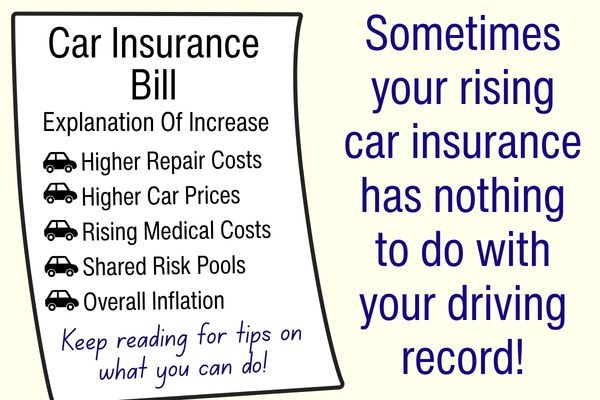
Shared Risk Pools
Your insurance premiums may go up for a reason that might seem very unfair if you’re a safe driver who has never filed a claim: Shared risk pools.
Insurance companies use shared risk pools to divide the odds of a claim amongst a larger number of clients. In other words, drivers’ insurance premiums all go into a single pool. One out of ten drivers may file a claim. All the drivers’ premiums are used to pay that claim.
Sharing losses and spreading risk is one strategy that helps insurance companies make money. But if multiple people in a given pool file a claim, or a few people file very expensive claims, the insurer needs to increase premium rates to make enough money to cover the claims, plus administrative costs and all the other expenses that go into operating an insurance company.
Insurance companies don’t just put every driver into the same bucket. They create shared risk pools based on driving records, vehicles, location, the type of coverage, and other factors, which might even include your credit score.
If drivers in your risk pool file more claims, or more expensive claims, your rates will go up, even if you weren’t responsible for the claims. Shopping around for a new insurance policy may help.
Overall Inflation
If you’ve checked your insurance bills recently, you probably already know that car insurance prices continue to rise every year.
But you might be surprised by how much car insurance costs are going up. According to the Bureau of Labor Statistics, car insurance premiums rose roughly 64% between December 2020 and December 2025, with the largest increase (20.3%) in 2023.
This inflation is occurring because of the factors above. Tariffs that drive up the price of parts and repairs, increased medical costs, riskier driving habits, plus rising administrative and operational costs are driving up insurance prices.
Like any company, insurance carriers exist to make money. As the price of electricity and other resources rise, along with the cost-of-living, which drives up salaries, it costs more to run an insurance company on a day-to-day basis. These operational cost increases lead to premium increases.
It’s all connected. And it all affects your bottom-line budget when you’re paying for car insurance.
Quick Tips to Lower Your Insurance Premiums
Fortunately, if you’re a good driver with no tickets, accidents or claims, you’re still in the driver’s seat when it comes to lowering your insurance premiums.
Here are a few ways to use your good driving record to your benefit:
- Take a defensive driving course
- Shop around for different companies
- Negotiate with your current carrier
- Ask about safe-driver and claim-free discounts, perks and other benefits
- Agree to using a telematics device to track your driving habits
The information provided on this website is for general informational and educational purposes only and should not be considered legal, financial, or insurance advice. While we strive to keep content accurate and up to date, insurance laws, policies, and regulations can vary by state and may change over time.
Nothing on this site constitutes professional advice or a recommendation of any specific insurance product, provider, or strategy. You should consult with a licensed insurance agent, financial advisor, or legal professional regarding your individual situation before making any decisions.
Sources
https://www.thezebra.com/auto-insurance/how-to-shop/average-auto-insurance
https://www.kbb.com/car-advice/when-will-car-prices-drop
https://doi.sc.gov/959/Recovery-What-to-Do-Coming-Out-of-A-Stor
https://content.naic.org/article/why-are-my-insurance-premiums-increasing
https://www.bls.gov/news.release/cpi.t02.htm