If you have a mortgage on your home, you’re required by the lender to have homeowners’ insurance. But for people who’ve paid off their home loan and the uber-wealthy, spending money on homeowners’ insurance is a choice. The average homeowners’ insurance policy is over $2,700, and high-risk states like Florida and Louisiana pay double or triple the national average, or even higher. With insurance premiums rising faster than inflation, some homeowners are considering doing away with their policies and self-insuring instead. In this article, you’ll learn what it means to self-insure, how much you could actually save, and three factors to consider before making this move.
What Does It Mean to Self-Insure Your Home?
Self-insuring means dropping your homeowners policy (or never buying one to begin with) and setting aside your own money to cover a future loss. This strategy is popular across all types of insurance, especially for those who have trouble getting approved for a policy or whose policies cost so much that it’s hard to justify paying the premium.
When you self-insure your home, you’re setting aside money to cover potential claims for damage, theft, or a total loss. Additionally, you’re now covering against injury claims for people who visit or do work at your home.
Rather than paying a premium to an insurance company, you’re paying the money to yourself. Ideally, you’re building a dedicated fund that you’d tap if disaster struck. Many people who choose to self-insure have established reserves in the form of cash, stocks, bonds, or other liquid assets, or they may have easy access to cash by borrowing against a different asset other than their home.
If you’re thinking about self-insuring your home, remember that almost all mortgage lenders require borrowers to maintain homeowners insurance until the loan is paid off. This protects their interests and ensures they’ll be repaid in case of a loss or that the home won’t fall into disrepair while the loan is still outstanding. For these reasons, self-insuring is really only available to those who own their home free and clear of any debt.
What Does Homeowners Insurance Actually Cover?
Before canceling your homeowners’ policy, it’s critical to understand what this insurance actually covers. A typical homeowners policy covers four things:
- Dwelling coverage. If your home is damaged or destroyed, it pays to repair or rebuild the structure of your home itself.
- Personal property. This protection covers your belongings, from furniture to electronics. Some belongings, like jewelry, have specific coverage limits unless you pay extra for a rider that covers its appraised value.
- Liability protection. Pays for claims if someone is injured on your property and sues you.
- Loss of use. If your home is uninhabitable after a covered loss, it pays for temporary housing until you can move back in.
While the home has a set value and a cap on how much you can lose, many homeowners forget that they have near-unlimited liability in case someone is injured on your property. It may be easy to think about paying for your own roof repairs after a hailstorm, but it’s substantially more expensive to absorb the cost of a lawsuit after a guest is seriously hurt on your property.
How Much Could You Actually Save by Self-Insuring?
If you’re a numbers guy like me, you’ll want to run the numbers to determine how much you can actually save by self-insuring your home. And this is what I recommend any of my clients do if they’re thinking of canceling their homeowners’ policy.
Calculating how much you can save is pretty straightforward. The first part of the equation is your annual insurance premium. If you’re paying the national average of $2,500, then you’d save $25,000 over the course of a decade before factoring in inflation. You must also factor in your deductible since you’d pay that amount if you have a claim on your policy over that 10-year timeframe.
While the savings can sound substantial, you’re assuming that nothing goes wrong.
If there’s a severe storm, a fire, a burst pipe, or an injury claim, those savings can evaporate quickly. Just the cost of a new roof can easily run $30,000, which negates a decade of saving from self-insuring.
The costs escalate from there if the home is a total loss. Not only do you have to pay to replace the structure out of pocket, but you won’t have insurance to replace your possessions like furniture, appliances, clothing, or electronics. And you’ll also have to pay for a place to live while your home is being rebuilt.
3 Situations Where You May Have Trouble Getting a Policy
Self-insuring isn’t always a choice. Some homeowners are pushed toward it because they can’t find affordable coverage where they live. In today’s market, homeowners in certain parts of California and Florida have had their policies canceled, and insurers aren’t accepting new policies.
If any of these apply to you, it’s worth knowing where you stand:
- High-risk locations. Coastal properties, wildfire zones, and flood-prone areas have seen insurers non-renew policies or exit the market entirely, leaving homeowners with few options besides expensive surplus-line carriers.
- Aging homes or roofs. Many insurers won’t write a new policy on a roof older than 15-20 years. If they are willing to cover it, they require an inspection before writing a new policy.
- A rough claims history. Multiple prior claims, even on a previous home, can make you a harder sell to underwriters and push your premiums up sharply.
3 Factors to Think About Before You Self-Insure
If you’re mortgage-free and genuinely weighing this strategy, work through these questions honestly before you cancel a policy and self-insure your home:
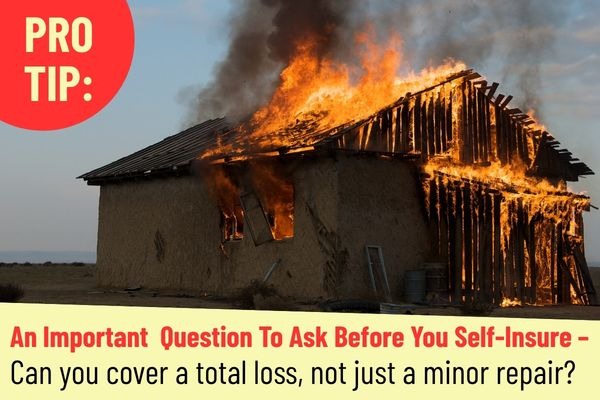
- Can you cover a total loss, not just a minor repair? Setting aside money for a burst pipe is reasonable for many homeowners. Having enough money to fully rebuild after a fire is a much bigger number than most people expect.
- What about liability? Without a policy, there’s no coverage if someone gets hurt on your property and sues. That exposure doesn’t go away just because you stopped paying premiums.
- Where does the money actually live? A self-insurance fund only works if it’s liquid and accessible on short notice. You don’t want the money tied up in a retirement account or volatile investments you’d have to sell at a loss to access quickly.
Alternatives to Self-Insuring
If the appeal is really about cutting costs rather than dropping coverage altogether, there are other ways you can save money without exposing yourself to risks of not having coverage on your home.
- Raise your deductible. A higher deductible lowers your premium while keeping catastrophic protection in place.
- Shop your policy every year. Rates vary widely between carriers, and loyalty rarely pays off the way people assume it does.
- Bundle your home and auto policies. This is still one of the most reliable ways to knock down your overall premium.
- Invest in risk reduction. A newer roof, a monitored security system, or storm-proofing can lower your premium and reduce your actual risk of claim at the same time.
- Self-insure selectively. Rather than dropping coverage entirely, you can raise your deductible enough that you’re effectively self-insuring the small stuff while keeping a policy in place for the catastrophic scenario that would actually wipe you out.
The Bottom Line
Self-insuring your home sounds like a great way to save money, but it isn’t a viable option for most homeowners. Most mortgage lenders require insurance coverage until the loan is paid off. However, if you’re mortgage-free or live in an area where insurance coverage isn’t available, self-insuring may be worth a look. If you’re going to forgo homeowner’s insurance, you’ll need significant liquid savings to rebuild your home or settle an injury claim out of pocket.
For nearly everyone else, I recommend focusing on reducing your premium rather than eliminating your coverage. You can save money on your premiums by raising your deductible, comparing quotes regularly, and investing in upgrades that reduce your risk. While these savings are smaller, you won’t be one bad claim away from losing everything.
The information provided on this website is for general informational and educational purposes only and should not be considered legal, financial, or insurance advice. While we strive to keep content accurate and up to date, insurance laws, policies, and regulations can vary by state and may change over time.
Nothing on this site constitutes professional advice or a recommendation of any specific insurance product, provider, or strategy. You should consult with a licensed insurance agent, financial advisor, or legal professional regarding your individual situation before making any decisions.
Sources
- Progressive, How much does homeowners insurance cost? Accessed August 10, 2026.
- U.S. News, How To Self-Insure Your Home. Published August 6, 2026.
- Obrella, Should I Self-Insure My Home? Published March 6, 2024.
- Forbes Advisor, The Average Home Insurance Cost 2026. Published June 17, 2026.
- NerdWallet, How Much Is Homeowners Insurance? Average 2026 Rates. Published May 6, 2026.
- WPTV, Is self-insurance good idea for Florida homeowners? Published May 28, 2021.