Usage-based insurance (UBI), powered by telematics, has grown in popularity in recent years as the technology has evolved. Top providers like State Farm, Progressive, Geico and Allstate offer UBI programs to help drivers save money on their insurance premiums. But is it worth it?
Of course, insurance companies sell their telematics programs as something that rewards safe drivers and puts you in control of premium costs.
“Just drive safe and save money,” is what the insurance companies want you to believe.
Some companies promise that using their devices won’t raise your insurance premiums, even if the equipment catches you doing things like speeding or texting while driving.
These companies offer a discount just for using the device and then offer a bigger discount for good driving behavior. Your premiums may go up for other things, like accidents or claims. But the company says it won’t raise your rates based on the telematics data, although the discount you receive might be smaller if the technology doesn’t pick up safe driving habits.
On the other hand, some may raise your rates if you exhibit driving behavior that doesn’t meet their standards.
Let’s dive into how these devices work, what you could be sacrificing to save money on your car insurance, and if UBI could even help you become a better driver.
How Do Telematics Work?
Telematics devices EW used to determine premium costs with a UBI policy. They use sensors and GPS to track your driving habits. Insurance companies then reward safe behavior, but may penalize behavior deemed risky.
Some devices track your driving exclusively through a mobile app on your phone. Others use a Bluetooth-powered beacon installed in your car that looks a bit like a toll pass transponder, coupled with a mobile app. Some systems use a device you plug into a port underneath your car’s dashboard.
For cars with multiple drivers, most programs track the aggregate data for every trip regardless of who’s driving.
If your insurer uses a mobile app, it may try to detect which driver it is based on the phone’s position in the car. That is, if your phone is in the driver’s seat or mounted on the dashboard, it’s likely to detect you as the driver. But these systems aren’t foolproof. Assume you’ll be judged, and your insurance rates will be determined, based on the habits of all the drivers in your household.
What Does UBI Track?
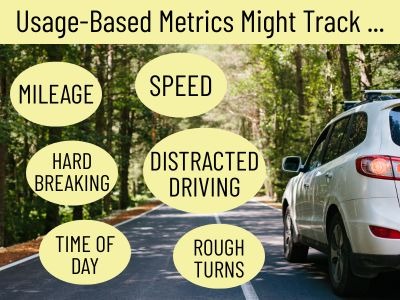
UBI metrics vary by insurance provider, but, in general, telematics devices track the following to gauge your driving habits and whether you regularly engage in what might be considered risky driving.
Mileage
Most insurance policies ask you to estimate your annual mileage or take odometer readings. Telematics devices give more accurate data based on your actual mileage and may offer discounts for cars driven less than average.
Time-of-day
More than 50% of traffic fatalities occur at night, even though people drive four times less frequently at night, according to figures from the National Safety Council. More non-fatal crashes tend to happen during rush hour, typically 4 PM to 8 PM.
If your telematics device shows you tend to stay off the road at these times, you could get a discount on your insurance bill.
Hard braking
Telematics devices can detect hard or sudden braking, which could be a sign you aren’t paying close attention on the road or that you’re tailgating other cars.
Rapid acceleration
Rapid acceleration may also be a sign of reckless or distracted driving. It also increases wear-and-tear on your car and burns fuel faster. Accelerating smoothly and evenly can help you save money on car insurance, repairs, and gas.
Speed
Staying within the posted speed limit may also give you an insurance discount on a UBI plan.
Rough turns
Some devices can detect rough or sudden turns or harsh cornering. Insurance companies reward drivers on UBI plans who decelerate prior to a curve and stay within the posted speed limit when turning.
Distracted driving
Devices can detect if you’re handling your phone while the vehicle is in motion. You might lose discounts for operating your phone while driving. To avoid this, plug in your destination on the GPS before you put the car in drive and use voice commands to operate your phone only when it’s completely necessary. With today’s technology, there’s little excuse to touch your phone while you’re driving, so this is an easy metric that can lower your car insurance rates on a UBI plan.
Pros of UBI
A UBI plan has many benefits for drivers who want to try a program.
- Can save safe drivers money
- May lower premiums if you don’t drive often
- May improve your driving habits
- Some programs offer a discount just for signing up
- The safer you drive, the more you can save
Cons of UBI
- Measures the behavior of all drivers of an insured car
- May not easily distinguish between drivers
- Data may not be accurate
- May require downloading an app or connecting a device to your vehicle
- If you exhibit bad driving habits, your insurance rates may increase or you’ll lose discounts
- Privacy concerns
Are Insurance Discounts Worth Risking Your Privacy?
The main concern people have about UBI plans is that your insurance company collects your private driving data, including your location, speed, the miles you drive and even when you’re on the road.
This could put your data, including the driving route you regularly take to work, into the wrong hands if there’s a data breach. Insurance companies may also sell your data to third parties, even if it’s stripped of personal information first.
UBI apps may also share your driving behavior data with other drivers in your household on the same plan. This may lead to friendly rivalry or can cause arguments if one driver’s habits lead to rate increases.
Important note: Current or past victims of domestic violence in certain states can request their data not be shared on a UBI plan with other drivers in their household.
Whether the insurance discounts are worth sacrificing your privacy in any way is a personal question.
Also keep in mind that if the data shows less-than-desirable driving behavior, even in areas you can’t control like commuting during rush hour, your insurance rates could rise.
UBI plans benefit very specific types of drivers:
- Low-mileage drivers
- Drivers who are extremely safe
- Drivers in less congested areas (where there’s less of a chance that you’ll need to brake suddenly)
It may also benefit teen drivers who haven’t had time to show a safe driving record but exhibit safe behaviors on the road.
Usage-Based Insurance vs. Pay-per-Mile
It’s important to understand the difference between usage-based insurance (UBI) and a pay-per-mile insurance plan.
Some insurance companies offer pay-per-mile plans for infrequent drivers. A mileage-only based program charges you a specific rate based on the miles you drive each month. Miles can add up quickly, though, leading to a high insurance bill. Some companies that offer pay-per-mile options want payment upfront for the year, which can make budgeting difficult.
If you primarily use public transportation, work from home or have a very short commute, or otherwise don’t drive very often, a pay-per-mile plan might be more cost-effective. But beware that if you regularly exceed mileage caps (either daily, monthly or annually) set by your insurer, it could be more costly than a regular policy.
Also, some states don’t allow pay-per-mile insurance.
If you’re shopping for car insurance and considering a UBI plan, be sure to find out whether you’re paying based on mileage only or on overall driving behaviors.
How Much Can You Save with Usage-Based Insurance?
Pay-per-mile insurance may save some drivers as much as 40% annually, while delivering the same level of coverage, including liability, collision, comprehensive coverage and gap insurance. But these plans aren’t common because most drivers don’t meet the low mileage requirements.
On the other hand, UBI plans that track your driving habits are becoming the norm. As auto insurance premiums rise across the board, telematics may be the best way to secure discounts and keep your car insurance affordable.
Consumer Reports did a survey and found that discounts were all over the place for insurance carriers that offer UBI plans. The median savings across all carriers was $120.
Younger drivers saved the most, with a median savings of $245 annually.
Discounts can range from 10% to 40% with major insurance carriers. Some companies offer 5% to 10% off your premiums just for signing up. But most drivers don’t see the full discount for various reasons.
Before you agree to telematics-based discounts, ask if your driving behaviors could increase your rates. That might not be a risk you want to take right now.
The information provided on this website is for general informational and educational purposes only and should not be considered legal, financial, or insurance advice. While we strive to keep content accurate and up to date, insurance laws, policies, and regulations can vary by state and may change over time.
Nothing on this site constitutes professional advice or a recommendation of any specific insurance product, provider, or strategy. You should consult with a licensed insurance agent, financial advisor, or legal professional regarding your individual situation before making any decisions.
Sources:
https://www.amfam.com/insurance/car/ubi-programs
https://injuryfacts.nsc.org/motor-vehicle/overview/crashes-by-time-of-day-and-day-of-week
https://www.experian.com/blogs/ask-experian/pros-and-cons-pay-per-mile-insurance