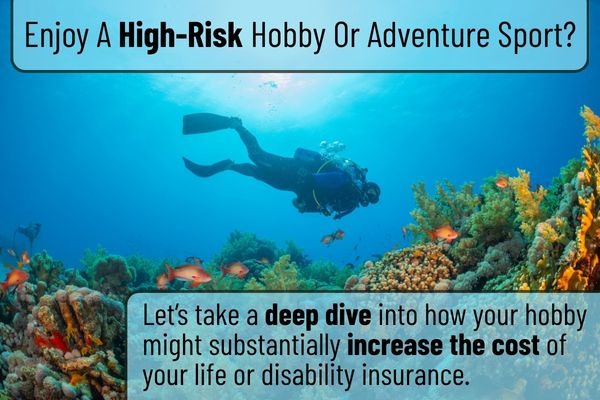
Not everyone is what you might call an adrenaline junkie. According to one study by YouGov.com, fewer than one-in-five Americans have participated in sports or hobbies that can be called “high risk.” But for those that do, their life and disability insurance costs can increase substantially based on the activities they enjoy. It can also be harder, but not impossible, to find coverage.
Risky Hobbies: Thrills vs. Costs
If you’ve ever jumped out of a plane, swam to the depths of an ocean, climbed mountains or taken a car around a turn at 100+ miles per hour, you know the risk is worth it to you. It’s a huge thrill that can make you feel super-human. As a paintball player and roller coaster enthusiast, I personally seek out that adrenaline rush in safer ways that don’t affect my insurance rates.
But if you’re involved in a sport perceived to be more dangerous than average, like scuba diving, recreational flying, skydiving, BASE jumping, rock climbing, or motor racing, it’s important to know what to expect in terms of insurance costs and your insurability.
And if you think you can just avoid mentioning your hobbies to the insurance company, you may want to reconsider. If you’re injured or killed while engaging in your favorite high-risk activity, your insurance company might not pay your claim if you didn’t disclose the activity.
It can be tempting to leave these activities off your insurance applications to save money. If an accident happens, it’s not worth the risk that you’ll be left without an income or your family will be left without access to life insurance payouts.
High-Risk Activities and Insurance: What You Need to Know
When you participate in a high-risk activity, insurance companies carefully evaluate your application to determine the risk they’re taking on. They might handle your application in one of three ways:
Deny coverage: They can refuse to write you a life or disability policy if they perceive you to be too high of a risk
Exclusion: Add an exclusion rider, which means the insurer won’t pay out any claims for injuries or death resulting from the named activity, but your rates will be the same as if you didn’t participate
Flat extra premium: Another option is to pay a flat extra premium, which is a specific additional dollar amount per every $1,000 of coverage. You may need to find a specialty insurer to take on this risk.
When you apply for coverage, your insurance agent may ask if you have any dangerous hobbies or plan to start any of these hobbies within the next six months. They might ask how often you participate and if you plan to continue participating after your policy is in force.
What If You Quit Your Hobby or Take Up a New One?
If you take up a dangerous hobby years after you’ve been approved for life or disability insurance and your rate is set, you’re still covered with no extra charges.
However, some standard policies have hazardous hobby exclusions baked in, so read the fine print carefully to know if you’re covered during a dangerous activity. If not, you may want to look into a specialty policy that offers the coverage you need.
If your policy lapses or you look for new coverage, however, your rates could be higher or your insurer could add an exclusion if you’ve taken up a dangerous sport.
Some insurers also have a “duty-to-notify” clause. If you take up a dangerous hobby on a regular basis, you might have an obligation to tell your insurance company. Otherwise, that activity may not be covered even if you don’t have a specific exclusion on your policy.
On the other hand, if you drop an extreme sport and you’re paying a flat extra premium rate, you may qualify for a lower rate. Often, the insurance company will look for a period of inactivity, such as 12 months, before reducing your rate.
“Own-Occupation” Coverage and Extreme Sports
If you’re applying for a disability policy, individual disability insurance (IDI), or long-term disability (LTD), you can choose “any occupation” coverage or “own occupation” coverage.
With Own Occupation coverage, which is typically preferred by high earners in specialty professions like medicine, you can file a disability claim if you can’t work in your professional field, even if you might be able to work a different job.
“Any occupation” coverage only pays out if you can’t work at all or you have to limit your work hours because of your injury or illness.
If you’re looking to purchase an IDI policy with “own occupation” coverage and you engage in risky sports, your carrier may add an exclusion.
For instance, rock climbers may suffer hand or finger injuries, rotator cuff (shoulder) pain, elbow injuries or knee injuries. If you work in a field that requires full use of your hands and arms, it may be harder to get “own occupation” coverage without an exclusion for your hobby.
For instance, a surgeon needs to use their hands to perform their job. By using voice commands and voice-to-text, a lawyer could feasibly perform their job without typing.

Just How Dangerous Are These Sports and Hobbies?
Some of the activities frequently subject to exclusions or extra premium charges include:
- Sky diving
- BASE jumping
- Cave diving
- Scuba diving
- Flying as a private pilot
- High-speed motorsports
- Scuba diving
Alert Diver published a study ranking the most dangerous sports based on a one-in-a-million chance of dying, a figure known as a “micromort.” Mountaineer, specifically climbing Mount Everest, ranked first on the list, with the greatest chance of dying during the ascent.
BASE jumping, an activity frequently excluded from insurance policies or charged increased premiums, came in second, with a micromort of 431. Other activities ranked much lower but are also frequently singled out for insurance coverage exclusions or flat extra charges.
These included:
- Extreme skiing
- Paragliding
- Cave diving (spelunking)
- Parachuting
- Recreational Diving
Frequency Matters
Insurance companies look at how dangerous a sport is, in general. They also consider how often you engage in the activity. For instance, if you go scuba diving twice a year on vacation, you’re considered a lower risk than someone who does open water dives every weekend. If you keep the depth to 75 or 100 feet (depending on your insurance underwriter) you can further reduce your risk profile, according to PolicyGenius.com.
Likewise, if you only climb indoor rock walls on weekends with your kids, that’s considered safer than outdoor mountain climbing. Any climbs above 10,000 feet or on ice could lead to flat extra surcharges, according to WSJ Buyside.
If you compete on an amateur or professional level in a motorsport, that’s considered more risky than someone who goes out for fun a few times a year.
Certifications Could Reduce Risk Exposure and Lower Your Insurance Rates
You may be able to reduce your risk profile with continuing education or certifications in your favorite hobby.
Private pilots, for example, may be considered lower risk if they have more education and more flight hours, plus a favorable Instrument Flight Rules (IFR) rating.
Tell the Truth, the Whole Truth
The more information you provide about your hobbies, the frequency, and your level of education or certifications, the more likely you’ll be able to secure a favorable rate, especially if you’re a hobbyist.
Even if you don’t think your risk profile is favorable, telling the truth minimizes your chance of a denied claim if you’re injured or killed participating in the sport.
Finding Lower Rates with Specialty Insurers
If you’re having trouble finding disability or life insurance coverage because of your hobbies, consider specialty insurers. You might ask fellow hobbyists who they use or turn to organizations focused on your favorite extreme sports.
Conclusion
Risky sports and activities like skydiving or piloting private plans can lead to higher life and disability insurance rates, exclusions where your insurer won’t pay a claim for a death or injury related to the activity, or simply denial of coverage.
Insurance companies have different underwriting guidelines, so shopping around can help you find lower rates. Working with a specialty insurer can give you the coverage you need even if you’re involved in high-risk activities. Shop around for lower rates from a carrier who works with adventure sports enthusiasts to save money and ensure continuous coverage.
The information provided on this website is for general informational and educational purposes only and should not be considered legal, financial, or insurance advice. While we strive to keep content accurate and up to date, insurance laws, policies, and regulations can vary by state and may change over time.
Nothing on this site constitutes professional advice or a recommendation of any specific insurance product, provider, or strategy. You should consult with a licensed insurance agent, financial advisor, or legal professional regarding your individual situation before making any decisions.
Sources
https://yougov.com/en-us/articles/44945-how-do-americans-feel-about-extreme-sports-poll
https://www.kinimaphysio.com.au/blog/common-climbing-injuries
https://www.usnews.com/insurance/life-insurance/what-are-life-insurance-exclusions
https://www.policygenius.com/life-insurance/scuba-divers