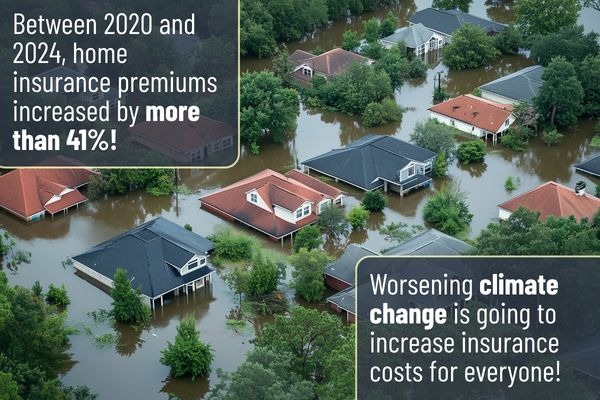
If you’re a homeowner in a state like California or Florida, you’ve probably already experienced higher home insurance premiums following natural disasters like floods, hurricanes, or wildfires. Wherever you live in the US, if your home insurance hasn’t already gone up, brace yourself as that day might come soon. Climate change is causing more severe weather events, extreme weather in unexpected areas, and more property losses that insurance companies have to pay. The insurance companies pass those costs onto homeowners in the form of higher premiums.
I personally experienced a nearly 50% hike in my home insurance in 2026 after 17 years with no claims. We didn’t make any major changes to our home, didn’t add any named perils like a pool or trampoline, and yet our premium cost went up.
I’m not alone in this. Between 2020 and 2024, home insurance premiums increased by more than 41%, according to data reported by the Levy Economics Institute of Bard College, a nonprofit, nonpartisan public policy research organization.
Meanwhile, deductibles are rising, putting homeowners in difficult financial situations if they need to file a claim. Let’s look at the real effects of climate change across the US, how these weather events are costing insurance companies and their customers more money, and some of the sneaky ways insurance companies are trying to maintain profitability.
How Climate Change Is Affecting Weather Patterns
To understand why insurance companies are raising rates, it’s important to first look at the real dangers of climate change in our environment.
According to NASA data, climate change is causing:
- Marine heat waves
- Heat extremes
- High-tide flooding
- Floods
- Heavy precipitation
- Droughts
- Wildfires
- Tropical Cyclones
Similarly, the National Climate Assessment reported that the frequency and strength of heat waves, heavy downpours, and hurricanes have increased in recent years. Any of these events can lead to property damage and insurance claims.
The Cost of Climate Change
Between 2000 and 2024, these perils, and others, have cost the US $3.2 trillion dollars, with tropical cyclones accounting for $1.6 trillion, or nearly half, of the total costs. Severe storms cost more than $618 billion, the second highest amount reported by The Center for Climate and Energy Solutions.
Not every dollar was paid out by insurance companies, of course; these totals reflect the costs of not just homes but infrastructure, vehicles, boats, agricultural assets, business interruption, disaster restoration, and wildfire suppression. The totals do not include the costs of human lives or medical costs.
In summary: Natural disasters and extreme weather events are increasing in frequency and strength as a result of climate change, driving up recovery costs.
A Note on the Science Behind Climate Change
Scientists attribute the extreme weather patterns to several different factors:
- Glaciers and ice sheets are melting in our world’s largest bodies of water, creating rising sea levels, more pronounced coastal flooding, and storm surges
- Increased evaporation from oceans causes more intense rainfall, leading to floods
- Warmer oceans are leading to stronger hurricanes that grow faster, leaving people with less time to secure their property and evacuate to safer grounds
At the same time, heat waves and droughts are creating dry conditions in other regions, making lands ripe for wildfires.
How Extreme Weather Costs Insurance Companies
What does all this science have to do with your insurance rates?
While natural disasters cost the US economy trillions over the past three decades, they cost the global economy $417 billion in 2024, alone, according to statistics from Gallagher Re, reported by Risk&Insurance.
Insured losses totaled $154 billion, which is 27% higher than the recent 10-year average. Insured losses are growing at a rate of 3.9% annually, more than double the rate of total economic losses, according to the report.
“[I]nsurers must balance the need for financial stability with their critical role in providing protection against increasingly unpredictable natural catastrophes,” wrote the R&I Editorial Team.
In other words: To stay in business and continue to serve their clients, insurance companies must increase premium rates or find other ways to save money, such as higher deductibles, reduced administration costs, and risk prevention.
Let’s look at some of the specific reasons insurance costs more today as a result of climate change.
More and Higher Payouts from Extreme Weather Events
In 2024, insurance companies experienced 21 incidents leading to multi-billion-dollar claims, the most in history. Severe Convection Storms, the most expensive weather event in recent decades, cost US insurers $120 billion in 2023 and 2024, representing the lion’s share of the global $143 billion insurance cost of SCS events.
Meanwhile, hurricanes Helene and Milton represented $20 billion in US losses, each.
If insurance went up in your neighborhood following a natural disaster, you’ve experienced the economic effects of severe weather events first-hand. Our insurance went up slightly after Superstorm Sandy ravaged the Northeast and decimated homes just south of my Long Island town.
But sometimes it’s more subtle than that; insurance companies will hike premiums in lower risk areas, spreading the increased cost of claims amongst more customers. That’s what happened with my recent rate hike; my family absorbed some of the costs from claims caused by events across the US.
Increased Reinsurance Costs
Insurance companies protect themselves against risk by purchasing reinsurance. A reinsurance contract reduces an insurance company’s liability to pay out past a certain amount in the face of multiple large or unexpected claims.
The reinsurance company shares the risk with the insurance company, allowing them to balance their profit and loss during a natural disaster, when they might have more claims than usual for higher-than-expected amounts.
Just like your insurance goes up if you make frequent claims or appear to be high risk, the reinsurance companies increase premium rates if an insurance company has made frequent claims or has many customers in a high-risk region.
As reinsurance rates rise, the insurance companies pass those costs onto customers in the form of higher premium rates.
Dropping High-Risk Customers
Insurance companies can look to reduce their risk by dropping customers in certain high-risk regions. Roughly 14% of owner-occupied homes in the US are uninsured, according to LendingTree. Some homeowners who don’t have a mortgage stay uninsured by choice. But some homeowners in high-risk areas can’t find insurance.
Between 2018 and 2023, more than 1.9 million homeowners were dropped by their home insurance company, according to a report from the Senate Budget Committee.
You might think that dropping high-risk customers would reduce premium rates. But fewer customers means less income for insurance companies. Premium rates might rise to cover that gap.
Premiums Stay the Same, But Coverage Levels Drop or Deductibles Rise
Even if your home insurance rates haven’t increased, it’s important to review your policy at renewal time. Some insurers have switched to percentage-based deductibles rather than a flat dollar amount. If you have to file a claim, especially for a total loss or catastrophic damage, you might find a 5% deductible to be unaffordable. Deductibles might vary for different types of losses, which is why you should read the policy carefully.
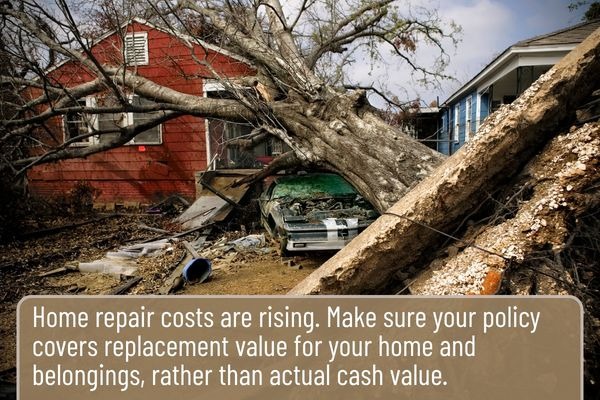
Also, make sure your policy covers replacement value for your home and belongings, rather than actual cash value. This trips a lot of people up, but if your roof, siding, windows, or the contents of your home are damaged in a major weather event, you’ll want the insurance company to pay to replace them.
Conclusion
Climate change is real and so are its effects on home insurance premiums. Rates have increased by more than 41% in recent years due to the frequency and severity of claims. If your insurance has increased, shop around today for a better rate and consider bundling home and auto insurance for more savings.
The information provided on this website is for general informational and educational purposes only and should not be considered legal, financial, or insurance advice. While we strive to keep content accurate and up to date, insurance laws, policies, and regulations can vary by state and may change over time.
Nothing on this site constitutes professional advice or a recommendation of any specific insurance product, provider, or strategy. You should consult with a licensed insurance agent, financial advisor, or legal professional regarding your individual situation before making any decisions.
https://www.hbs.edu/bigs/climate-change-upending-homeowners-insurance
https://science.nasa.gov/climate-change/extreme-weather
https://www.edf.org/climate/climate-change-and-extreme-weatherhttps://matic.com/blog/2026-home-insurance-report/
https://www.lendingtree.com/insurance/homes-uninsured-study
https://www.linkedin.com/pulse/your-homeowners-insurance-part-emergency-plan-ashley-harris-wt5we