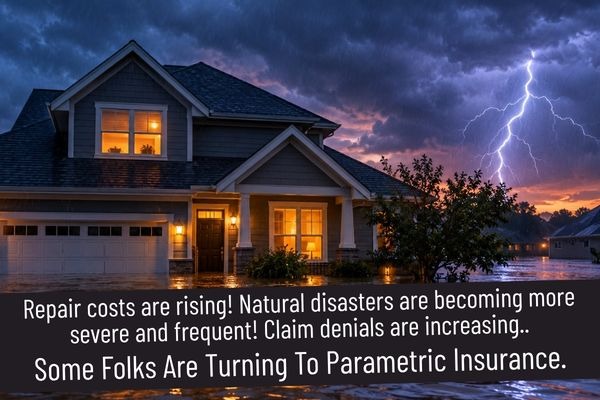
Homeowners’ insurance protects your home against normal risks like fire, wind, and theft. But many homeowners find these policies aren’t enough because repair costs are rising, natural disasters are becoming more severe and frequent, and claim denials are increasing. This is especially true for homeowners in states with more frequent hurricanes, wildfires, and floods. Making matters worse, several major carriers have pulled back or restricted new business in higher-risk states, and many homeowners now face hurricane and wind deductibles of $10,000 or more. Parametric insurance was once a niche product, but is becoming more common among today’s homeowners. Learn more about what parametric insurance is, how it differs from homeowners’ insurance, and whether it makes sense to buy a policy.
What Is Parametric Insurance?
Parametric insurance pays out a preset amount when a specific, measurable event occurs instead of calculating what your actual losses are. This insurance is also known as index-based insurance. Since its payouts are predetermined, your home doesn’t need to be inspected for damage, and you don’t need to meet with a claims adjuster. Instead, insurers track independent data sources (such as wind speed readings, rainfall totals, or a storm’s distance from your address) to determine claim eligibility. When the data crosses an agreed-upon threshold, you receive an automatic payout whether your home has been damaged or not.
For example, a policy might promise a fixed payout if a hurricane’s sustained winds reach 100 mph within a defined radius of your home. The payout occurs even if your home incurs no damage, such as losing roof shingles. Some policies use tiered triggers to determine how much you’ll receive. The payouts increase as the measured event grows more severe. For instance, you’ll receive a bigger payout for 30 inches of snowfall in 72 hours than for 20 inches.
Parametric coverage is generally sold as an add-on or standalone supplemental policy. It is not a replacement for your standard homeowners insurance, so don’t think that you can swap one policy for the other. In my experience, this coverage is designed to enhance your existing coverage by filling specific gaps you’re worried will affect your home.
How Parametric Insurance Differs From Standard Homeowners Insurance
Traditional homeowners insurance is what’s known as indemnity coverage. You file a claim after your home has been damaged and the insurance reimburses you for your actual, documented loss, up to your policy limits and after accounting for your deductible. To get paid out with a traditional homeowners’ policy, you’ll need to file a claim, have an adjuster inspect the damage, then negotiate repair costs and wait for payment. In some cases, this process can take weeks or even months. In the meantime, your home either sits damaged or you have to pay out of pocket for repairs and hope to be reimbursed once your claim is approved.
Parametric insurance flips that model and reduces the stress and headaches of traditional homeowners’ insurance. No damage assessment is needed, and you don’t have to meet with an adjuster to trigger payment. The insurer relies on objective third-party data to determine whether you receive payment or not. This data often comes from sources like NOAA, radar networks, or certified weather stations, rather than someone’s opinion, which can vary from one adjuster to the next. Once the policy is triggered, the payout is automatic and is typically disbursed within days to a few weeks.
The ease and speed of parametric insurance payouts come with a trade-off known as basis risk. Since this policy’s payouts are tied to the measured parameter rather than your actual damage, my experience is that the payout doesn’t always match the cost of repairs. For example, your home could sustain significant damage from a storm whose wind speeds fell just short of your policy’s trigger. In that situation, the parametric policy doesn’t pay a single dime toward your repair costs. Conversely, you could receive a full payout even if your home came through relatively unscathed.
Understanding and accepting this mismatch risk is central to deciding whether parametric coverage is worth adding.
Comparing Traditional Homeowners’ Insurance vs. Parametric Insurance
| Traditional Homeowners Insurance | Parametric Insurance | |
| Payout basis | Actual documented damage | Predefined trigger (wind speed, rainfall, etc.) |
| Claims process | Adjuster inspection, proof of loss | Verified against third-party data |
| Payout speed | Weeks to months | Days to a few weeks |
| Payout amount | Matches assessed loss (minus deductible) up to policy maximum | Fixed amount, set in advance |
| Best used for | Repairing/rebuilding actual damage | Fast cash for deductibles, temporary needs |
What Gap Does Parametric Insurance Fill?
Parametric insurance isn’t meant to replace your homeowners policy. When working with clients, I typically recommend it to plug specific holes that traditional coverage tends to leave open. Parametric insurance is similar to what AFLAC is for your medical insurance, or what gap insurance is for your auto policy.
- High deductibles. Many homeowners in hurricane-prone states now carry wind or hurricane deductibles in the five-figure range. A parametric payout can cover out-of-pocket costs so you’re not scrambling for cash before your traditional claim even kicks in.
- Non-damage expenses. Temporary housing, transportation, lost income, or emergency supplies aren’t always covered by traditional homeowners’ insurance, especially if your home wasn’t damaged badly enough to be declared uninhabitable. Parametric funds arrive quickly, regardless of documented physical loss, to ease the financial burden while going through the claims process of your homeowners’ policy.
- Excluded structures. Standard homeowners’ policies often limit or exclude coverage for detached items like docks, seawalls, fences, or gazebos. Parametric add-ons can be structured to cover these directly, avoiding gaps in your home’s coverage.
- The gap while a traditional claim is pending. Even with good coverage, a big storm can mean a long wait for an adjuster and a settlement, especially if dozens or hundreds of homes in your local area are affected. A fast parametric payout can bridge that gap by providing quick cash to cover upfront repair costs or a contractor deposit while waiting for your main claim to be approved.
- Thinning coverage in high-risk markets. In areas where carriers have restricted or exited the market (like California or Florida), parametric products from specialty insurers offer a layer of protection that may be hard to find at an affordable price.
How to Determine If You Should Buy It
Parametric insurance isn’t a fit for every homeowner. Here’s how I work with clients to determine whether this policy is worth paying for.
- Assess your risk exposure. If you live in a coastal, wildfire-prone, or flood-heavy region, parametric coverage is more likely to pay for itself. This is especially true where major carriers have recently restricted coverage or hiked premiums to unaffordable levels.
- Look at your deductible. Review your current homeowners’ policy to check your named-storm or wind/hail deductible. It can make sense to purchase a parametric policy that matches your deductible to reduce your financial exposure after a storm.
- Think about your cash-flow needs. If a major storm hit tomorrow, could you cover temporary housing, a contractor deposit, or emergency repairs while waiting weeks or months for your traditional claim to settle? If not, the speed and convenience of a parametric payout may be worth the premium.
- Weigh your tolerance for basis risk. Think about the possibility of receiving nothing if the storm falls just short of the trigger. Would you be okay paying these premiums even if it means you don’t receive any money?
- Do the math. Compare the premium against the specific gap you’re trying to close. These policies are often good for paying a large deductible or covering longer hotel stays while your home is repaired.
- Vet the provider carefully. Before buying, ask for policy specifics so you can track them yourself. Talk to your agent about what data sources are used, who verifies the data, if the payouts are tiered, and how quickly the money is disbursed.
The Bottom Line
Parametric insurance does not and should not replace the protection your standard homeowners policy provides. However, it provides quick access to cash when specific metrics are triggered, even if your home hasn’t sustained any damage. These policies are ideal for homeowners with high-deductible homeowners insurance or those living in a high-risk area where the traditional insurance market is tightening. I recommend that clients identify the specific gap in their coverage, then price out a parametric policy that matches their risk. If you’re unsure whether it fits your situation, talk with a licensed agent who can walk you through your existing policy and risk profile.
The information provided on this website is for general informational and educational purposes only and should not be considered legal, financial, or insurance advice. While we strive to keep content accurate and up to date, insurance laws, policies, and regulations can vary by state and may change over time.
Nothing on this site constitutes professional advice or a recommendation of any specific insurance product, provider, or strategy. You should consult with a licensed insurance agent, financial advisor, or legal professional regarding your individual situation before making any decisions.
Sources
- Arbol, Hurricane Insurance in 2025: How Parametric Coverage Fills the Growing Protection Gap. Published May 20, 2025.
- Merlin Law Group, Parametric Hurricane Insurance. Published November 2, 2024.
- Coastal Roofing of South Florida, What Is Parametric Insurance For Roofs? Published November 28, 2025.
- KSA Insurance, What Is Parametric Hurricane Insurance? Accessed September 8, 2026.
- Insurance Curator, Parametric Insurance: a Faster Payout Model for Hurricane and Wildfire Losses. Published June 16, 2026.
- Milliman, Parametric insurance: An untapped solution for public entities. Published September 2, 2025.
- Aon, Parametric Insurance. Accessed September 8, 2026.
- United Policyholders, A New Option for Disaster Insurance: Parametric. Accessed September 8, 2026.
- USI, 2026 Personal Insurance Outlook: The Hidden Cost of Doing Nothing. Published January 6, 2026.
- Congress.gov, Parametric Insurance for Natural Disasters: Frequently Asked Questions. Published May 19, 2026.
- American Property Casualty Insurance Association, PARAMETRIC COVERAGE: How it can assist during recovery from natural disasters. Published January 2026.