
While most couples want to have a baby, getting pregnant doesn’t always come easy. When you can’t conceive naturally, you’ll need to see a doctor to find out what’s happening and how you can increase your chances of having a baby. This may include taking medication, having a procedure, or giving it more time. Drugs and medical procedures can be costly and waiting can take an emotional toll on everyone involved.
If you’re having trouble getting pregnant, don’t feel like you’re alone. Millions of families face this same issue, and it’s estimated that 1 in 5 Americans will struggle with infertility at some point in their lives. Company healthcare plans are increasingly offering fertility benefits, but be careful because fertility benefits vary from one plan to the next. Here’s what you need to know about fertility coverage, what to look for in your insurance plan, and how to pay for fertility care if it’s not covered by insurance.
Why Fertility Coverage Matters
Having a baby naturally is costly. And when you need fertility treatments, the costs only increase. On average, you’ll pay $12,000 to $25,000 for one round of in-vitro fertilization (IVF), and some couples need two or more rounds before getting pregnant. The costs depend on your location, which doctor you use, and your diagnosis and treatment plan. If your plan includes additional medication, your bill will be even higher.
Since many patients require multiple rounds of IVF to become pregnant, it is important to prepare yourself financially and emotionally if it doesn’t work the first time. With an average of 2.5 rounds of IVF, the cost to get pregnant through fertility treatments can easily go over $40,000.
Couples who are unable to get pregnant through IVF or choose not to go that route, surrogacy is another option. However, these costs can be even higher. Prepare to spend anywhere from $100,000 to $250,000 or more to have your baby through a surrogate.
With such high costs, some couples have to choose between emptying their bank accounts or delaying their dream of starting a family.
Where Fertility Coverage Comes From
Fertility coverage typically comes from state mandates or employer benefits. Interestingly, a proposed standalone benefit may be an option in the near future.
State Mandates
According to RESOLVE, the following 14 states plus Washington, D.C., require some form of employer coverage for IVF: Arkansas, California, Colorado, Connecticut, Delaware, Hawaii, Illinois, Maine, Maryland, Massachusetts, New Hampshire, New Jersey, New York and Rhode Island. California launched this mandate on January 1, 2026, while Arkansas and Hawaii have some caveats to their coverage requirements.
Keep in mind that state laws may not cover you if your employer’s healthcare benefits are self-funded versus traditional insurance. Speak with your Human Resources (HR) department to see what type of plan you are on, what benefits you may have available, and how time off works when the baby is born.
Employer Benefits
Employers are filling much of the gap when it comes to fertility treatments. Half of employers with more than 500 workers now cover IVF, which is up from 27% in 2020. However, smaller employers typically don’t offer these benefits due to cost and complexity.
Even when your employer offers fertility benefits, the coverage usually comes with limits. Among large employers, there is a median lifetime maximum of $25,000 and a median cap of three cycles. If your employer offers these benefits, they’re usually provided through a specialty fertility company, like Progyny, Carrot, or Maven.
A Proposed Standalone Fertility Benefit
In May 2026, a federal proposal emerged that would enable fertility benefits to be offered as a standalone benefit outside of health insurance, similar to how most people buy vision and dental coverage. The latest proposal includes treatment and testing for infertility with a lifetime maximum benefit of up to $120,000.
As of October 2026, this rule has not passed. As it is currently written, employers will not be required to provide this benefit, but they can offer it to attract and retain employees.
What to Look For in a Fertility Benefit
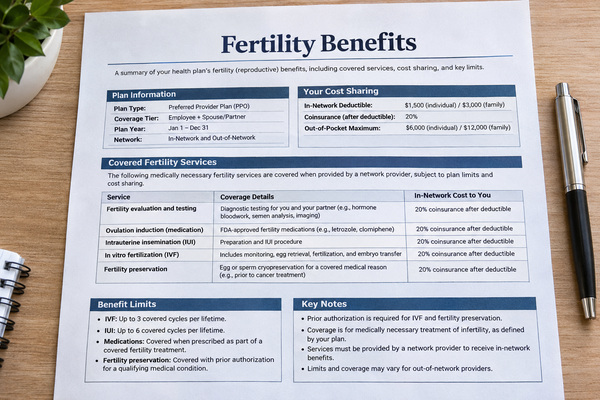
Even when a plan advertises that it includes “fertility benefits,” what that means can vary from one plan to the next. I always tell my clients to dig deeper into their benefits package to understand what’s included, what’s not, and how much is covered before starting the IVF process.
Here are some questions to ask about your plan’s fertility benefits.
Fertility Benefit Checklist
| Feature | Why It Matters | What to Ask HR or Your Insurer |
| Lifetime dollar maximum vs. cycle limits | A $25,000 maximum may cover only one or two cycles, while a cycle-based limit may stretch further | “Is my benefit capped by dollars, cycles, or both?” |
| Fertility medications | Drugs can account for nearly 20% of an IVF cycle’s cost and are sometimes covered separately | “Are fertility drugs covered, and do they count toward my maximum?” |
| Definition of infertility | Many plans follow the American Society for Reproductive Medicine’s definition, which was broadened in 2023 to include LGBTQ+ and single people | “Who qualifies, and do I need a diagnosis or a waiting period first?” |
| Egg and embryo freezing | Fertility preservation is often excluded unless it’s medically necessary, such as before cancer treatment | “Is elective egg or embryo freezing covered, including storage fees?” |
| Genetic testing of embryos | Testing can add thousands of dollars per cycle | “Is preimplantation genetic testing covered?” |
| Clinic network | Some benefits limit you to specific clinics or doctors | “Can I use my preferred clinic, or must I stay in network?” |
| Prior authorization | Some plans require approval or a set number of less invasive treatments before IVF | “What approvals or earlier treatments are required before IVF?” |
| Age limits | Some plans stop covering treatment after a certain age | “Is there an age limit for coverage?” |
| Donor eggs, donor sperm, and surrogacy | These are commonly excluded, even from generous plans | “Are donor and surrogacy costs covered, or is there a separate stipend?” |
If you’re unfamiliar with any of these terms, our guide to health insurance terms everyone should know can help.
Surrogacy: The Biggest Coverage Gap
If you want to have a baby, but cannot carry a pregnancy yourself, surrogacy may be your best option. However, keep in mind that it can be expensive, yet more difficult to purchase insurance coverage for the surrogate and your fetus. According to Carrot data reported by Axios, typical costs include:
- Surrogate compensation: $30,000 to $65,000
- Agency fees: $15,000 to $45,000
- Legal fees: $15,000 to $20,000
- IVF and medical expenses: $25,000 to $50,000
Insurance adds another layer of complexity. The surrogate’s own health plan may exclude a surrogacy pregnancy, so intended parents often buy a surrogacy-specific policy that can cost about $30,000 more. Have an attorney or agency review the surrogate’s policy before signing any agreement.
The good news is that employer support is growing. Employers reported a 39% year-over-year increase in adoption or surrogacy benefits. However, this coverage is often a reimbursement stipend rather than the traditional insurance process. Keep taxes in mind, too. In a 2025 letter ruling, the IRS allowed intended parents to deduct their own IVF costs but denied deductions for the surrogate’s medical care, compensation, and legal fees.
How to Pay for What Insurance Doesn’t Cover
Even with good coverage, most families face some out-of-pocket costs for fertility care. These strategies can help reduce the impact to your family’s finances.
- Use your HSA or FSA. IVF qualifies as a medical expense under IRS Publication 502, so you can pay eligible costs with pre-tax dollars from a health savings account (HSA) or flexible spending account (FSA). Plan ahead, since FSA funds usually must be used by the end of the plan year.
- Deduct medical expenses. Itemizing deductions may allow you to write off medical costs that exceed 7.5% of your adjusted gross income (AGI). Make sure you keep all your receipts and compare the total of your itemized deductions against the standard deduction.
- Drug discount cards. Fertility drugs may qualify for discounted pricing through programs like GoodRx or Mark Cuban’s CostPlusDrugs.com. You may be able to save as much as $2,200 a cycle through these programs.
- Speak with your clinic about packages. Clinics may offer packages that offer multiple cycles for a cheaper price. However, you may be out the extra money if you get pregnant on the first try.
- Compare plans during open enrollment. If your spouse’s employer or a new job offers stronger fertility benefits, it may be worth switching plans. Use the checklist above to compare your options side by side. You may also find our guide to hidden gaps in health insurance helpful.
The Bottom Line
Fertility and family-forming benefits are expanding, but many factors still come into play when trying to determine if your plan will cover your needs. During your open enrollment period review the fertility benefit packet and compare it with the list above. Look at your spouse’s plan to see if it offers better benefits, fewer exclusions, or higher caps. Consider signing up for a health savings account (HSA) or flexible spending account (FSA) to pay for some expenses on a pre-tax basis. If you’re still unsure, speak with a licensed agent or benefits counselor to learn more about your options.
The information provided on this website is for general informational and educational purposes only and should not be considered legal, financial, or insurance advice. While we strive to keep content accurate and up to date, insurance laws, policies, and regulations can vary by state and may change over time.
Nothing on this site constitutes professional advice or a recommendation of any specific insurance product, provider, or strategy. You should consult with a licensed insurance agent, financial advisor, or legal professional regarding your individual situation before making any decisions.
Sources
- Federal Register, Excepted Fertility Benefits (Proposed Rule). Published May 13, 2026.
- Forbes, At $23,000 An IVF Cycle, Fertility Benefits Are ‘Life Changing’ For Workers. Will They Keep Growing? Published June 13, 2026.
- Mercer, Fertility treatments: standalone benefit options and TrumpRx. Published October 30, 2025.
- Maven Clinic, In what states is IVF covered by insurance? Updated October 15, 2026.
- HR Brew, More state lawmakers seek to mandate IVF insurance coverage, but threats abound. Published July 23, 2026.
- Axios, The steep cost of surrogacy. Published March 29, 2026.
- Axios, New infertility definition a “game-changer” for hopeful LGBTQ+ parents. Published October 23, 2023.
- The Tax Adviser, IRS approves medical deduction for IVF, denies it for surrogacy. Published November 30, 2025.
- GoodRx, Is IVF Tax Deductible? Published January 11, 2024.