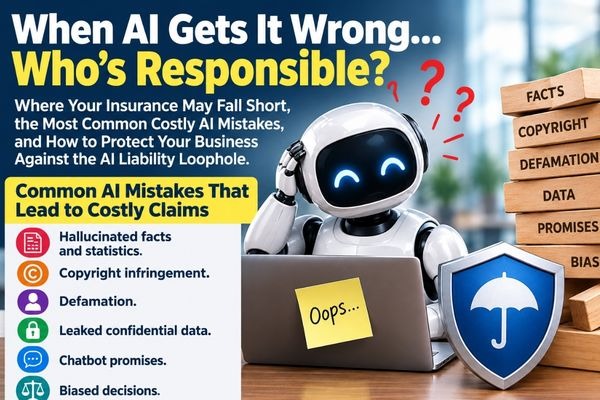
While many freelancers and small business owners are scared of how artificial intelligence (AI) could impact their businesses, the reality is that generative AI tools have become essential business tools for freelancers and startups. They draft copy, write code, summarize research, and answer customer questions in seconds. The downside is that these same AI tools also make mistakes, and they can deliver inaccurate information or conclusions with total confidence. Imagine handing a client a report with an AI-generated statistic that turns out to be fake, or your company’s chatbot promising a refund you never offered and can’t afford. When that mistake costs money, the AI company won’t pay, your client blames you, and your business insurance may exclude your claim. Here’s who’s actually responsible when AI gets it wrong, where your insurance may fall short, the most common costly AI mistakes, and how to protect your business against the AI liability loophole.
What Is the AI Liability Loophole?
The AI liability loophole is when you find out that you’re responsible for generative AI errors, even when you think you’re covered by insurance, contract language, and other protections. When an error occurs, it seems like everyone passes the buck and points their fingers at someone else expecting them to pay for the damages. However, the bottom line is that the person ultimately responsible for writing a check is probably going to be you, the freelance writer.
While the AI tools themselves are the ones making the mistakes, companies that build AI tools have disclaimed their liability to end users through their terms of service. Companies such as OpenAI, Microsoft, Google, and Anthropic admit that their AI responses may not be correct. In fact, they have disclaimers reminding you about “AI hallucinations” and the need to fact check their responses. If they accept any liability, most cap their payments at the total amount amount you’ve paid them over the last 12 months.
If you think you’re covered by an insurance policy, think again because insurance carriers are bailing out on liability as well. In 2026, more than 60 property and casualty insurance carriers have requested permission to insert AI exclusions into policies going forward. Insurance commissioners have approved more than 80% of these exclusion requests. So, while you may have been covered in the past, when you get a new policy or renew your current insurance, AI liability claims may now be explicitly excluded. Some of these carriers include Chubb, Travelers, AIG, and W.R. Berkley.
With the rise of generative AI content, lawsuits are becoming more common. In 2025, more than 800 consumer AI related lawsuits were filed against US companies, which was a 140% increase over the prior year. If your AI vendor isn’t covering you and your insurance carrier is excluding the loss, you’ll be paying the claim out of pocket.
Who’s Responsible When AI Makes a Mistake?
When AI makes a mistake, there are three potential parties who could be responsible for paying the claim. However, the responsibility usually falls on the business that used the tool.
The AI Company
Unfortunately, AI companies don’t take responsibility for anything they produce, unless it’s copyrighted material. Companies such as OpenAI, Microsoft, Google, and Anthropic may cover some of the claim if their AI tools create something copyrighted. However, this coverage only applies if you have a paid business plan. Free versions don’t receive this coverage.
For example OpenAI will protect you if you are using their API or ChatGPT Enterprise plan. Since most freelancers operate as solo entrepreneurs, they typically don’t pay for large-scale enterprise licenses. The coverage also doesn’t apply if you alter the AI’s prompt in any way or if someone claims your content was false or libelous.
You, the Business Using the Tool
Courts have made it clear that AI output is your work product. In Mata v. Avianca, lawyers who filed a legal brief citing fake court cases invented by ChatGPT were fined $5,000. In Moffatt v. Air Canada, the airline’s chatbot told a grieving customer he could apply for a bereavement discount after his trip. Air Canada argued it wasn’t responsible for its chatbot’s statements, but the court called that argument “remarkable” and ordered the airline to pay anyway.
Your Client
Clients outsource content creation to freelancers and small business owners. They expect that the content is original, factually correct, and doesn’t make any false claims. However, who’s responsible for claims depends on your agreement with your client.
For example, if you state that all work is to be original and free of errors and don’t mention that content may be generated by AI, you will most likely be held responsible for all claims. Similarly, if the contract expressly states that content should not be generated by AI, you’re in violation of the contract if you used AI to create the content.
Where Your Insurance May Fall Short
Until recently, most business policies didn’t mention AI, so AI-related claims were often covered by default because it wasn’t expressly excluded. However, that is changing as new policies are written and existing policies are renewed.
Starting January 1, 2026, many insurers are attaching new generative AI exclusions to general liability policies. Here’s how the major policies stack up.
Does Your Policy Cover AI Mistakes?
| Policy | What It Normally Covers | The AI Gap | What to Ask Your Agent |
| General liability (CGL) | Bodily injury, property damage, and personal and advertising injury, such as defamation or ad-related infringement | ISO’s optional exclusions can remove AI-related claims from the whole policy (CG 40 47) or just from personal and advertising injury (CG 40 48), like AI-written content that defames a competitor | “Is CG 40 47, CG 40 48, or a similar AI exclusion attached to my policy? Please send me the actual wording.” |
| Professional liability (E&O) | Claims that your work caused a client financial loss through errors, omissions, or negligence | Some policies exclude AI hallucinations, IP infringement, or claims arising from your reliance on third-party AI tools | “If an AI tool gives me a wrong statistic and my client loses money, am I covered?” |
| Cyber liability | Data breaches, hacking, ransomware, and notification costs | Built for security incidents, not for wrong AI answers or copyright claims over AI-generated content | “Does my policy cover client data I enter into an AI tool if that data is later exposed?” |
| Directors and officers (D&O) | Lawsuits against a company’s leaders over management decisions | Some forms now carry AI exclusions, and the broadest can wipe out coverage for almost any claim tied to AI use, such as AI-assisted hiring or pricing decisions | “Does my D&O policy have an AI exclusion, and does it cover defense costs for a regulatory investigation?” |
| Affirmative AI coverage | A newer specialty policy or endorsement built specifically for AI risk | Covers AI failures like hallucinations and inaccurate outputs, but it’s still new and built mainly for companies whose products rely on AI | “Is an AI exclusion buyback or a standalone AI policy available, and what would it cost?” |
Ask these questions if you have a BOP instead of general liability as well. I am a freelance writer that uses AI to generate ideas, do research and even summarize competitor articles and long-research papers. If that summary cites incorrect numbers, and I used it on a client’s project, it is not the AI company’s fault. If the claim isn’t covered by my professional liability policy, I’d be on the hook to pay that claim. Learn more about how to cover your business in our business insurance for beginners article.
Common AI Mistakes That Lead to Costly Claims
Most AI-related claims trace back to a handful of predictable mistakes:
- Hallucinated facts and statistics. AI tools can invent numbers, quotes, and sources that sound real. Verify every fact against the original source before it reaches a client.
- Copyright infringement. AI-generated text, images, or code can closely resemble someone else’s work. Run important content through a plagiarism checker, and avoid prompting for work “in the style of” a specific creator.
- Defamation. AI can state false information about real people or companies. Double-check any claim that could damage someone’s reputation.
- Leaked confidential data. Pasting a client’s financials or unpublished work into a free AI tool may expose it. Use business plans with data protections, or remove sensitive details first. Ask your client for permission before sharing any proprietary data with a third-party like an AI tool.
- Chatbot promises. As Air Canada learned, customers can hold you to what your chatbot says. Limit what your bot can promise, and review its answers regularly.
- Biased decisions. Startups using AI for hiring or lending decisions can face discrimination claims. Keep a human involved in the final decision.
How to Protect Yourself and Your Business
You don’t need to stop using AI to create content, but you do need to protect yourself and your clients. Follow these steps to close most of the AI liability loophole in your writing.
- Read your policy on renewals. Most likely they will have an endorsement added to your current policy for AI. Request your agent to provide you with this wording to know how your coverage is affected.
- Ask your insurance provider about AI coverage. Endorsements covering AI outputs can be purchased from some carriers. Some specialty insurance companies provide AI liability policies.
- Purchase a Business Plan. Many AI companies offer business plans that come with copyright protection and better data privacy. Be aware of what these plans cover and what they don’t. Some will not protect your usage if you alter the output or merge outputs.
- Have language about AI in your contract. Let your clients know how you’re using AI. In your contract, limit your liability to what they’re paying for the job. Don’t promise that your work will be 100% created by you or that it will be free from errors.
- Use a human to fact check AI generated content. Think of AI generated content as your first draft. I always double check my facts when using AI for client deliverables.
- Document your review process. Take notes on how you fact check AI generated content. Make sure the content aligns with the client’s voice and style guide. Then, have an experienced writer or editor review all facts, figures, and statements to ensure they are sourced with legitimate publications and cited correctly.
The Bottom Line
There are many ways that you can use AI to save time. Whether you’re a freelancer or running a small start up, AI tools can allow you to take on larger projects and compete with much bigger companies. The problem is when something goes wrong? If you’re trying to figure out who’s responsible, the answer is typically you. In many cases, you’ll be responsible for mistakes made by any AI tools your company uses. The terms and conditions in most AI provider contracts typically state that they will not be held liable for errors, and courts have ruled that anything created using AI is yours.
Insurance companies are now excluding claims arising from AI generated content, so that means if you’re business falls under the AI Liability Loophole its on you to pay for the consequences. Review your Insurance and one of your top used customer agreements this week and see what your business may be at risk for. Speak with an agent about covering yourself from any expensive mistakes made from AI that can cost you big.
The information provided on this website is for general informational and educational purposes only and should not be considered legal, financial, or insurance advice. While we strive to keep content accurate and up to date, insurance laws, policies, and regulations can vary by state and may change over time.
Nothing on this site constitutes professional advice or a recommendation of any specific insurance product, provider, or strategy. You should consult with a licensed insurance agent, financial advisor, or legal professional regarding your individual situation before making any decisions.
Sources
- Reworked, AI Terms of Service Make You Responsible for Risks. Published May 14, 2026.
- CSIS, The Insurance Industry’s Retreat from AI Threatens to Slow Innovation and Adoption. Published September 4, 2026.
- Serotonin Legal, AI Indemnification Clauses: What Your Vendor Covers. Published September 22, 2026.
- Justia, Mata v. Avianca, Inc., 1:2022cv01461 – Document 54 (S.D.N.Y. 2023). Published June 22, 2023.
- AI Business, Air Canada Held Responsible for Chatbot’s Hallucinations. Published February 20, 2024.
- Testudo, ISO’s Generative AI Exclusions: CG 40 47, CG 40 48, CG 35 08. Published August 20, 2026.
- Honigman, The AI Insurance Gap and What It Means for Technology Contracts. Published May 27, 2026.
- Beancount.io, The AI Coverage Gap: Why Your Business Insurance May Not Cover Losses From the AI Tools You Already Use. Published July 13, 2026.
- Armilla, Armilla Launches Affirmative AI Liability Insurance with Lloyd’s Underwriter, Chaucer. Published April 30, 2025.
- Boring Insurance Agency, What is the generative-AI exclusion on my liability policy, and what does it take away? Accessed October 28, 2026.